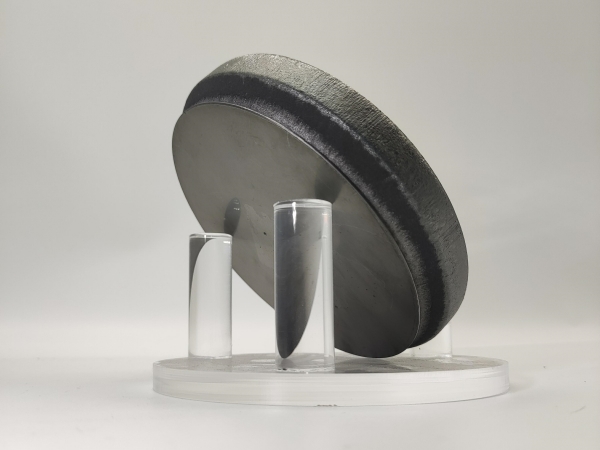
The core requirements of RF devices (such as 5G/6G base station power amplifiers, satellite communication devices, and national defense radars) are low loss, high power, high-frequency response, and long-term reliability. 4H-semi-insulating SiC (silicon carbide) substrates, with their unique material properties, perfectly meet the stringent requirements of RF devices and have become the mainstream choice in the industry. The core reasons can be divided into the following five dimensions, balancing performance, compatibility, and economy.

I. Excellent Semi-Insulating Properties, Greatly Reducing RF Parasitic Loss
During the operation of RF devices, it is necessary to avoid signal leakage to the substrate and reduce parasitic coupling, otherwise signal attenuation and efficiency reduction will occur, which requires the substrate to have extremely high resistivity. 4H-SiC can achieve semi-insulating properties with resistivity >10⁹ Ω·cm through vanadium doping compensation technology, which is much higher than the RF device requirement of >10⁵ Ω·cm. It can effectively confine RF signals within the active layer of the device, maximize the suppression of parasitic loss and signal interference, and ensure the fidelity and transmission efficiency of high-frequency signals. In contrast, traditional silicon substrates have extremely low resistivity, and although sapphire substrates have insulating properties, other key performances are difficult to match, which cannot meet the needs of mid-to-high-end RF devices.
II. Excellent Compatibility with GaN Epitaxial Layers, Ensuring Device Performance Stability
Current mainstream RF devices (such as HEMT high electron mobility transistors) adopt GaN (gallium nitride) heterostructure epitaxial structures, and the matching degree between the substrate and the GaN epitaxial layer directly determines the quality of the epitaxial layer and the reliability of the device. 4H-SiC has significant advantages in this dimension:
• High Lattice Matching Degree: Both 4H-SiC and GaN belong to the hexagonal crystal system, with lattice constants of 3.073 Å and 3.189 Å respectively, and the mismatch degree is only about 3.5%, which is much lower than that of silicon substrates (mismatch degree >16%). The threading dislocation density can be effectively filtered through the AlN nucleation layer, controlling the threading dislocation density to the order of 10⁸ cm⁻², avoiding dislocations from becoming leakage channels or non-radiative recombination centers, and ensuring device efficiency and reliability.
• Thermal Expansion Coefficient Adaptation: The thermal expansion coefficient of GaN is about 5.6×10⁻⁶/K, and that of
4H-SiC is about 4.3×10⁻⁶/K. The difference between the two is only about 30%, which is much smaller than the thermal mismatch of GaN-on-Si (difference >100%). It can effectively reduce the thermal stress generated during the cooling process of epitaxial growth, avoid wafer warpage and epitaxial layer cracking, and ensure the process stability of large-size wafers.
III. Ultra-High Thermal Conductivity, Solving the Thermal Management Problem of RF Devices
RF devices (especially high-power amplifiers) generate a lot of Joule heat during operation. If the heat cannot be dissipated in a timely manner, it will lead to an increase in channel temperature, a decrease in electron mobility, and even device burnout. Thermal conductivity is one of the core performance indicators of the substrate. The thermal conductivity of 4H-semi-insulating SiC is as high as 350-450 W/(m·K), which is second only to diamond among semiconductor materials, 3 times that of silicon, and more than 10 times that of sapphire. It can quickly conduct the heat generated in the GaN active region to the heat sink, effectively suppressing the channel temperature rise. For example, the thermal resistance of GaN RF devices using 4H-SiC substrates can be reduced by more than 70% compared with
sapphire substrates, allowing higher power output at the same junction temperature. It is especially suitable for scenarios requiring continuous wave operation such as 5G base station power amplifiers, greatly improving the long-term reliability of devices.
IV. Superior Electrical and Physical Properties, Adapting to High-Frequency and High-Power Requirements
The inherent electrical and physical properties of 4H-SiC are naturally suitable for the trend of RF devices upgrading to high frequency and high power:
• Wide Bandgap Advantage: The bandgap width of 4H-SiC reaches 3.26 eV, which is much higher than that of silicon (1.12 eV) and GaAs (1.43 eV). It has a higher breakdown field strength (3.5 MV/cm), can withstand higher operating voltage, reduce the risk of device breakdown, and adapt to the needs of high-power RF devices.
• Outstanding High-Frequency Performance: The electron saturation drift velocity of 4H-SiC is at least twice that of silicon, which can support devices to work stably at higher frequencies, especially suitable for 6G submillimeter wave band (above 100 GHz) applications. It is one of the few substrate materials that can meet the output power and efficiency requirements of this frequency band at the same time.
• Strong Chemical Stability: 4H-SiC has excellent chemical inertness and mechanical strength, can withstand harsh processes such as high temperature and corrosion during the preparation of RF devices, and remains stable in complex working environments such as outdoors and aerospace, improving the radiation resistance and aging resistance of devices.
V. Outstanding Cost-Effectiveness, Adapting to Large-Scale Industrial Application
Large-scale application of RF devices is inseparable from cost control. While meeting high-performance requirements, 4H-semi-insulating SiC substrates have significant cost-effectiveness advantages:
• Controllable Cost: GaN self-supporting substrates are difficult to prepare, have slow growth rate and low yield. The market price of 2-inch substrates can reach several thousand US dollars, and large-size wafers are difficult to mass-produce. In contrast, 4H-SiC substrates have achieved large-scale mass production of 6-inch wafers, and 8-inch production lines are under promotion. The scale effect has continuously reduced the cost, and the unit area cost is only 40% of that of GaN self-supporting substrates of the same size.
• Significant Comprehensive Benefits: The lower dislocation density and higher thermal conductivity brought by 4H-SiC substrates can improve device yield, reduce chip area, and lower packaging and heat dissipation costs. Finally, the comprehensive cost per watt of output power of GaN-on-SiC RF devices is 50-60% lower than that of GaN self-supporting schemes, greatly improving the feasibility of industrialization.
In summary, 4H-semi-insulating SiC substrates perfectly meet the core needs of RF devices (especially mid-to-high-end GaN-based RF devices) through the comprehensive advantages of "low parasitic loss, high matching, excellent thermal management, strong high-frequency performance, and high cost-effectiveness". Therefore, they have become the preferred substrate material in the RF field, widely used in key fields such as 5G/6G communication, satellite communication, and national defense radar.