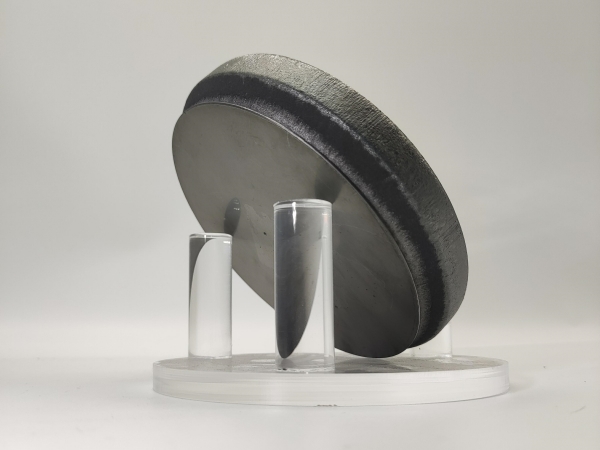
1. Product Positioning: Ga₂O₃ Single-Crystal Substrates – Core Carrier for Ultra-Wide Bandgap High-End Devices
Compared with the sapphire heteroepitaxy route, our self-developed EFG-grown β-Ga₂O₃ single-crystal substrates serve as the core base for high-end ultra-high voltage power devices, thoroughly solving heteroepitaxy pain points such as lattice mismatch, interface defects and element interdiffusion. They possess four irreplaceable core advantages:
1.
Zero Lattice Mismatch & Ultra-Low Defect Density: Homoepitaxy eliminates twin crystals, stacking faults and rotational domains, reducing the dislocation density of epitaxial films by 1–2 orders of magnitude. The device breakdown voltage exceeds 10 kV, suitable for high-voltage power devices above 1200 V.
2.
Ultimate Material Performance: Inheriting the intrinsic 4.9 eV ultra-wide bandgap and 8 MV/cm ultra-high breakdown field of Ga₂O₃, its Baliga figure of merit is 11 times that of SiC and hundreds of times that of silicon-based materials. Under the same withstand voltage, devices feature smaller size, lower conduction loss and higher energy efficiency.
3.
Superior Doping Controllability: Free from Al element diffusion interference existing in sapphire substrates, ion implantation and in-situ doping achieve higher dopant activation efficiency, enabling stable, high-concentration and repeatable n/p bipolar doping, ideal for vertical power devices, PN junction diodes and high-end optoelectronic devices.
4.
Continuous Upgraded Mass-Production Sizes: 2/4-inch substrates have achieved stable mass production, and 6-inch samples have completed R&D iteration, compatible with 8-inch
silicon production lines, laying a long-term mass-production layout for high-end power devices.
Product Gradient Positioning: Sapphire substrates focus on the low-cost large-scale civilian market, while Ga₂O₃ single-crystal substrates target the high-performance, high-reliability ultra-high voltage high-end market, fully covering the diverse demands of industry customers.
2. First-Principle DFT Simulation: Fundamental Mechanism of p-type Conductivity via Phosphorus Doping
To accurately verify the doping advantages of Ga₂O₃ substrates, a complete β-Ga₂O₃ supercell model was constructed. CASTEP density functional theory (DFT) was adopted to quantitatively analyze the formation energy of phosphorus substitution defects, electronic band structure and Fermi level evolution, revealing the atomic-scale mechanism of p-type conductivity.
2.1 Simulation Lattice Model

[Figure 1 ] Ball-and-stick structural diagram of Ga₂O₃ lattice (a: intrinsic Ga₈O₁₂, b: P-substituted O-site model, c: P-substituted Ga-site model; brown = Ga, red = O, light purple = P)
The intrinsic β-Ga₂O₃ belongs to the C₂/m space group. Our single-crystal substrates perfectly replicate this standard lattice structure without lattice distortion or interface defects. In contrast, sapphire heteroepitaxy suffers from inherent lattice mismatch due to different crystal systems, which disturbs the formation of acceptor levels and reduces doping efficiency.
2.2 Defect Formation Energy: Ga₂O₃ Substrates Facilitate High-Efficiency Acceptor Defect Formation
Core simulation data confirms that phosphorus atoms preferentially substitute oxygen sites in the Ga₂O₃ lattice (P_O defects) with a neutral formation energy of 7.44 eV and high thermodynamic stability. In comparison, the formation energy of Ga-site substitution defects (P_Ga) is as high as 9.65 eV, which is thermodynamically unfavorable.
Moreover, higher oxidation states of phosphorus correspond to lower defect formation energy. The formation energy of pentavalent phosphorus substituting oxygen sites is only 2.42 eV, which easily forms shallow acceptor levels in the lattice and continuously generates hole carriers. Free from foreign element interference, Ga₂O₃ single-crystal substrates possess a higher proportion of high-valence phosphorus acceptor defects, delivering far superior hole concentration and conductivity stability than heteroepitaxial systems.
2.3 Band Structure and Fermi Level Evolution

[Figure 2 ] Band structure and projected density of states of P_O doping series (dashed line represents Fermi level)

[Figure 3 ] Band structure and projected density of states of P_Ga doping series (dashed line represents Fermi level)
Simulation results show that phosphorus doping introduces stable shallow acceptor levels in the valence band of Ga₂O₃. The Fermi level decreases quadratically with the increase of phosphorus oxidation state, approaching the valence band maximum and continuously improving hole carrier concentration and mobility.
Core fitting formulas:
O-site doping system: Ef=0.1067x²-0.9741x+4.3269 (R²=0.9907)
Ga-site doping system: Ef=0.1775g²-1.5171g+5.6190 (R²=0.9863)
Ga₂O₃ single-crystal substrates enable precise regulation of phosphorus ion valence distribution, realizing predictable and repeatable stable p-type conductivity, making them the optimal choice for high-end device doping processes.
3. SRIM Ion Implantation Simulation: Superior Doping Uniformity of Ga₂O₃ Substrates

[Figure 4 ] SRIM depth distribution curves of phosphorus ions under low, medium and high dosages
The multi-energy superimposed implantation process achieves uniform full-region doping with controllable concentration gradients. Compared with sapphire substrates, Ga₂O₃ single-crystal substrates completely eliminate reverse diffusion of substrate elements. No concentration attenuation or defect passivation occurs after high-dose doping. Ultra-high carrier concentration can be obtained without additional buffer layers, significantly simplifying the process flow and improving device yield and reliability.
4. Differentiated Selection Guide for Dual Substrate Products
| Product Solution |
Core Substrate |
Applicable Scenarios |
Core Advantages |
| Cost-Effective Mass-Production Solution |
Sapphire Substrate |
Consumer fast chargers, home appliance inverters, civilian UV detection, basic scientific research |
Low cost, large size, mature process, suitable for large-scale mass production |
| High-End Performance Solution |
Ga₂O₃ Single-Crystal Substrate |
New energy vehicle inverters, photovoltaic inverters, UHV power grids, high-end military optoelectronic devices |
Zero lattice mismatch, ultra-high breakdown voltage, high carrier concentration, no interface defects, high reliability |
5. Supporting Technical Services for Ga₂O₃ Single-Crystal Substrates
1. Mass Supply: Stable mass production of 2/4-inch semi-insulating and conductive Ga₂O₃ single-crystal substrates, with rapid delivery of customized 6-inch samples;
2. Full-Process Technical Support: Integrated services including DFT doping mechanism simulation, SRIM ion implantation parameter simulation and process optimization;
3. Process Matching: Mature complete process solutions including homoepitaxial MO
CVD growth, ion implantation and high-temperature annealing, helping customers rapidly launch high-end p-type Ga₂O₃ power devices.
6. Summary
Supported by mature phosphorus ion implantation doping technology, our sapphire substrates and Ga₂O₃ single-crystal substrates precisely meet the two core industry demands of low-cost mass production and high-performance R&D.
Sapphire substrates empower the large-scale industrialization of civilian semiconductor devices, while Ga₂O₃ single-crystal substrates support technological breakthroughs of high-end ultra-high voltage power devices. The dual-product layout fully covers the application scenarios of the fourth-generation semiconductor Ga₂O₃ industrial chain, providing customers with one-stop substrate and process solutions.