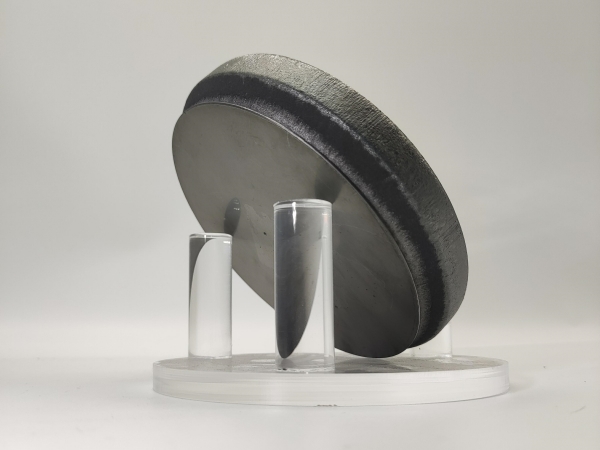
Among glass wafers, JGS1, JGS2, and JGS3 all belong to the quartz glass series, with high-purity silicon dioxide (SiO₂) as the core component, while BF33 is borosilicate glass, which has significant compositional differences from the former three. Therefore, the four types have obvious differences in characteristics and application scenarios. The following systematically sorts out their differences from three dimensions—core characteristics, key parameter differences, and application scenarios—to provide reference for selection.
I. Differences in Core Characteristics and Key Parameters
The core differences of the four types lie in melting method, hydroxyl (OH⁻) content, spectral transmission range, impurity content, thermal performance and mechanical performance. The specific parameter comparison and characteristic details are as follows:
JGS1 is synthetic far-ultraviolet quartz glass, prepared by chemical vapor deposition (CVD) process. Using gaseous silicon tetrachloride as raw material, it undergoes gas-phase reaction in oxyhydrogen flame to generate amorphous silicon dioxide and deposit, which is one of the representative models of high-purity quartz glass.
• Core parameters: Hydroxyl (OH⁻) content is about 1200ppm (some specifications can reach 950-1400ppm), and impurity content is extremely low (≤5ppm, total metal impurities can be less than 0.2ppm); transmission range is 0.17~2.10μm (or 185~2500nm), average transmittance ≥90%, among which the transmittance of 185nm deep ultraviolet band can reach more than 90%, with a strong absorption peak at 2730nm; birefringence constant is 2-4nm/cm, almost no fluorescence (excitation wavelength 254nm); thermal expansion coefficient is 5.5×10⁻⁷cm/cm·℃ (20℃-320℃), softening point 1683℃, annealing point 1215℃, which can resist 10¹⁰rad γ-ray and other radiation without discoloration.
• Core characteristics: Excellent optical uniformity, no obvious stripes and bubbles, outstanding deep ultraviolet light transmission performance, high chemical stability (excellent water and acid resistance except hydrofluoric acid), high thermal stability and laser damage threshold, and good dimensional stability. However, it has slight defects prone to stripes, and the maximum wafer diameter is ≤200mm.
JGS2 is gas-fused ultraviolet quartz glass, prepared by oxyhydrogen melting process with natural crystal as raw material, which is melted and accumulated by oxyhydrogen flame, and is the most widely used general-purpose quartz glass wafer.
• Core parameters: Hydroxyl (OH⁻) content is about 150ppm (some specifications 150-400ppm), impurity content 20-40ppm; transmission range is 0.26~2.10μm (or 220~2500nm), average transmittance ≥85%; birefringence constant 4-6nm/cm, strong fluorescence intensity (V-B band, excitation wavelength 254nm); thermal performance is basically the same as JGS1 (same thermal expansion coefficient, softening point, etc.), but radiation resistance is slightly weaker, and it will slightly discolor after radiation; maximum wafer diameter ≤300mm, which can prepare larger size products.
• Core characteristics: Good ultraviolet and visible light transmission performance, high chemical purity, mature processing technology, moderate cost, and excellent mechanical performance (sharing the same mechanical parameters as JGS1, such as density 2.20g/cm³, Mohs hardness 5.5-6.5). However, it has a small amount of particle structure, large-size products may have bubbles, and deep ultraviolet light transmission is weaker than JGS1.
JGS3 is electric-fused wide-spectrum quartz glass, prepared by electric melting process, focusing on optimizing the light transmission performance of infrared band and taking into account part of ultraviolet performance, which is a special model for wide-spectrum applications.
• Core parameters: Extremely low hydroxyl (OH⁻) content (≤5ppm), impurity content 40-50ppm; transmission range is 0.185~3.50μm (or 200~3500nm), average transmittance ≥85%, outstanding light transmission performance in infrared band (2.1~3.5μm), ultraviolet cut-off wavelength about 260-270nm; birefringence constant 4-10nm/cm, strong fluorescence intensity (V-B band); thermal performance is consistent with JGS1 and JGS2, maximum wafer diameter ≤200mm.
• Core characteristics: Excellent wide-spectrum light transmission, especially suitable for scenarios combining infrared and ultraviolet. Low hydroxyl content leads to weak infrared absorption, good chemical stability and thermal stability. However, the impurity content is slightly higher, the optical uniformity is slightly inferior to JGS1, and the birefringence fluctuates greatly.
BF33 is borosilicate glass, which has significant compositional differences from JGS series quartz glass. Its core components are SiO₂ (content >80%), B₂O₃, Al₂O₃, Na₂O. It does not belong to the category of quartz glass and is a general-purpose precision optical glass wafer.
• Core parameters: No obvious requirement for hydroxyl content, refractive index 1.47, transmittance ≥90% (visible light band), fluorescence phenomenon is much lower than soda-lime glass; thermal expansion coefficient 3.3×10⁻⁶/K (20-300℃), softening point 820℃, annealing point 560℃, strain point 520℃, which can work at 450℃ for a long time and resist rapid cooling and heating; density 2.23g/cm³, elastic modulus 67KN·mm⁻², tensile strength 40~120KN·mm⁻², excellent chemical stability (water and acid resistance reach ISO 1 level, alkali resistance ISO 2 level), which is an ideal material for anodic bonding with silicon wafers.
• Core characteristics: Excellent mechanical performance, light weight, high strength, wear resistance and scratch resistance, good thermal stability (can withstand sudden temperature changes), outstanding insulation performance, and lower processing cost than quartz glass series. However, deep ultraviolet light transmission is poor, which cannot adapt to high-end applications in ultraviolet band, impurity content is higher than JGS1, and optical uniformity is lower than quartz glass series.
II. Differences in Application Scenarios
The application differences of the four types are directly determined by their characteristics, which mainly correspond to the four core needs of "light transmission band, purity, thermal stability and cost". The specific application scenarios are as follows:
(1) Application Scenarios of JGS1
It is mainly suitable for "deep ultraviolet, high purity, high precision" scenarios, focusing on high-end optical and semiconductor fields, and is a core material with high requirements for light transmission and purity:
• Semiconductor field: Core consumables for semiconductor lithography process, such as deep ultraviolet (DUV) lithography photomask substrate, adapting to KrF excimer laser 248nm and ArF excimer laser 193nm wavelengths to ensure exposure efficiency and pattern precision; optical window sheets in semiconductor process equipment.
• Optical field: Deep ultraviolet optical components, such as excimer laser window sheets, lenses, prisms, high-precision reflectors; cuvettes and detector windows of ultraviolet spectrometers.
• Other fields: High-end optical components in medical equipment, laser substrates, thin film deposition substrates, and special optical scenarios requiring radiation resistance and high dimensional stability.
(2) Application Scenarios of JGS2
It is mainly suitable for "ordinary ultraviolet, visible light, medium and low-end high precision" scenarios, balancing performance and cost, and is the most widely used quartz glass wafer:
• Semiconductor field: Ordinary ultraviolet window sheets and packaging optical components in semiconductor manufacturing, as well as basic substrates for MEMS (micro-electro-mechanical systems) and CMOS sensors.
• Optical field: Lenses, prisms and optical flat panels of ordinary optical instruments; microscope slides and observation windows; optical window sheets in high temperature and high pressure environments.
• Other fields: Ordinary optical lenses of astronomical telescopes, auxiliary optical components in laser systems, and ultraviolet-visible light application scenarios without requirements for deep ultraviolet light transmission.
(3) Application Scenarios of JGS3
It is mainly suitable for "wide spectrum, infrared-based" scenarios, focusing on medium and high-end applications combining infrared and ultraviolet, taking advantage of its infrared light transmission with low hydroxyl content:
• Optical field: Infrared optical components, such as infrared lenses, infrared window sheets, thermal imaging protection windows; substrates of wide-spectrum optical systems, adapting to optical instruments in 200nm~3.5μm band.
• Special fields: Optical substrates of aerospace sensors, core components of infrared spectrometers; optical components of Nd:YAG laser systems, and special scenarios requiring both ultraviolet and infrared light transmission.
(4) Application Scenarios of BF33
It is mainly suitable for "visible light, medium and low-end precision, low cost" scenarios, focusing on general-purpose optical and semiconductor auxiliary applications, replacing quartz glass to reduce costs:
• Semiconductor field: Semiconductor display glass, silicon wafer anodic bonding substrate; auxiliary optical components in semiconductor processing, such as etching substrates (one of the preferred materials for fine etching).
• Optical field: Optical filters and ordinary optical windows of precision instruments; lampshades of floodlights and high-power spotlights, and optical scenarios with low requirements for fluorescence impact (such as component detection and biological fields).
• Other fields: Precision measurement equipment protection parts, chemical reactors, microchannel slides in medical and analytical technology; optical equipment with weight restrictions (light weight advantage); insulation components in high temperature environments.

III. Summary of Core Differences
1. Composition difference: JGS1/JGS2/JGS3 are high-purity quartz glass (mainly SiO₂), while BF33 is borosilicate glass (containing B₂O₃ and other components), which are essentially different types of glass;
2. Core light transmission difference: JGS1 focuses on deep ultraviolet, JGS2 on ordinary ultraviolet-visible light, JGS3 on wide spectrum (ultraviolet-infrared), and BF33 only adapts to visible light and part of near ultraviolet;
3. Purity difference: JGS1 > JGS2 > JGS3 > BF33, JGS1 has the lowest impurity content, suitable for high-end semiconductor scenarios;
4. Cost difference: BF33 < JGS2 < JGS3 < JGS1, BF33 has the highest cost performance, and JGS1 has the highest cost due to complex process;
5. Application priority: Deep ultraviolet, high precision → JGS1; ordinary ultraviolet, general optics → JGS2; wide spectrum, infrared → JGS3; visible light, low cost, general precision → BF33.