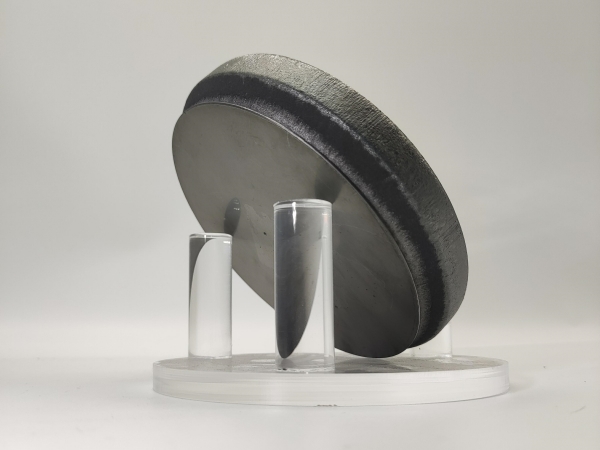
Molybdenum disulfide (MoS₂), a representative two-dimensional transition metal dichalcogenide (TMD), exhibits excellent semiconductor properties, optical transparency, and mechanical flexibility. These characteristics make it highly promising for applications in flexible electronics, optoelectronics, and quantum devices.
Sapphire (Al₂O₃) substrates are widely used for the heteroepitaxial growth of MoS₂ thin films due to their high chemical stability, favorable thermal expansion compatibility with MoS₂, and ability to achieve atomically smooth surfaces. However, key processing parameters of sapphire substrates—such as flatness, surface roughness, and crystal orientation accuracy—directly influence the nucleation density, grain size, lattice orientation consistency, and interfacial bonding quality of MoS₂ films, ultimately determining device performance.
This article analyzes three critical substrate parameters and their influence on MoS₂ thin-film growth mechanisms, crystallinity, and electrical/optical performance.

1. Key Sapphire Substrate Parameters and Control Standards
MoS₂ growth processes such as
chemical vapor deposition (CVD), physical vapor deposition (PVD), and molecular beam epitaxy (MBE) require high substrate surface quality. Among these,
MBE imposes the most stringent requirements.
| Parameter |
Key Metrics |
CVD Standard |
MBE Standard |
Processing Method |
| Flatness |
TTV (Total Thickness Variation), Warp |
TTV ≤ 5 μm, Warp ≤ 3 μm |
TTV ≤ 2 μm, Warp ≤ 1 μm |
Laser correction + chemical mechanical polishing (CMP) |
| Surface Roughness |
Ra, RMS |
Ra ≤ 0.5 nm, RMS ≤ 0.8 nm |
Ra ≤ 0.1 nm, RMS ≤ 0.2 nm |
CMP + plasma-assisted polishing |
| Crystal Orientation Accuracy |
Misorientation angle, lattice integrity |
≤ 0.5° |
≤ 0.1°, dislocation density ≤10³ cm⁻² |
XRD calibration and optimized crystal growth |
These parameters are typically specified for
2-inch sapphire substrates, commonly used in research and pilot production.
2. Influence of Substrate Flatness on MoS₂ Growth
Substrate flatness, characterized by
TTV and warp, determines thickness uniformity and macroscopic surface curvature. It directly affects:
Temperature distribution during growth
Uniformity of precursor adsorption and diffusion
Interfacial stress distribution
When flatness is within acceptable limits (e.g.,
TTV ≤5 μm and Warp ≤3 μm for CVD), a uniform thermal field forms across the substrate. Vapor precursors such as
MoO₃ and sulfur diffuse uniformly, resulting in
consistent nucleation density and uniform grain growth, producing dense films with thickness variation within
±5%.
If flatness exceeds tolerance (e.g., Warp >5 μm), local height variations create
temperature gradients of 5–10 °C, leading to:
Overgrowth of polycrystalline clusters in hotter regions
Insufficient nucleation in cooler regions
Film defects such as
pinholes, cracks, and delaminationExperimental results show that when
warp increases from 3 μm to 6 μm, MoS₂ carrier mobility decreases from
80 to 45 cm²/(V·s) and the on/off ratio drops from
10⁶ to 10⁴.
For
MBE growth, flatness requirements are even stricter because atomic-level deposition is highly sensitive to surface height variations.
3. Influence of Surface Roughness
Surface roughness, typically evaluated by
Ra and RMS, is a critical factor affecting
nucleation behavior, interfacial bonding, and carrier transport.
For
low-roughness substrates (Ra ≤0.5 nm for CVD or ≤0.1 nm for MBE):
Precursor atoms diffuse easily across the surface
Uniform nucleation sites form
Growth follows a
layer-by-layer (Frank–van der Merwe) mechanismThis enables the formation of
continuous monolayer or few-layer MoS₂ films with low interface trap density (<10¹¹ cm⁻²eV⁻¹). For example, sapphire substrates with
Ra ≈0.2 nm can support continuous monolayer MoS₂ films with
grain sizes of 5–10 μm and optical transparency above
90% in the visible spectrum.
If roughness exceeds
Ra >1 nm, surface irregularities create additional nucleation sites, leading to
island growth (Volmer–Weber mode). The result is:
Discrete nanocrystals rather than continuous films
Smaller grain size (<1 μm)
Increased grain boundaries and defects
Higher roughness also increases interface scattering and reduces carrier mobility. For instance, increasing Ra from
0.5 nm to 1.5 nm can reduce the photoluminescence quantum yield from
15% to below 3%.
4. Influence of Crystal Orientation Accuracy
Crystal orientation accuracy determines the
atomic arrangement on the substrate surface and its lattice compatibility with MoS₂.
Common sapphire orientations include:
c-plane (0001) – most widely used
a-plane (11-20)m-plane (10-10)Among them,
c-plane sapphire provides the most suitable atomic arrangement for MoS₂ growth.
When the orientation deviation is within specification (
≤0.5° for CVD, ≤0.1° for MBE), the substrate surface remains highly ordered, enabling
van der Waals epitaxy despite the lattice mismatch (~31%). MoS₂ grains grow with consistent orientation, producing large-area films with low defect density.
For example, on a
0.1° miscut c-plane sapphire substrate, MBE can produce monolayer MoS₂ with highly aligned crystal orientation and carrier mobility exceeding
100 cm²/(V·s).
If misorientation exceeds
1°, atomic alignment becomes disordered, causing:
Random grain orientation
High grain boundary density
Severe carrier scattering and reduced mobility
Excessive misorientation may also induce
lattice distortion, film cracking, and phase transitions (e.g., from semiconducting 2H phase to metallic 1T phase).
5. Synergistic Effects and Parameter Optimization
Substrate flatness, roughness, and crystal orientation interact synergistically rather than independently.
For example:
Poor orientation control amplifies nucleation disorder on rough surfaces.
Excessive warp can locally increase roughness and disturb temperature uniformity.
When multiple parameters exceed tolerance simultaneously, MoS₂ films may fail to form continuous layers and instead grow as isolated particles.
Optimization Strategies
For CVD GrowthPrefer
c-plane sapphire substratesControl parameters:
Orientation deviation ≤0.5°
TTV ≤5 μm
Warp ≤3 μm
Ra ≤0.5 nm
Apply
CMP + plasma polishingPerform
high-temperature annealing (800–1000 °C) before growth to remove surface contaminants.
For MBE GrowthUse
high-purity c-plane sapphireStricter specifications:
Orientation deviation ≤0.1°
TTV ≤2 μm
Warp ≤1 μm
Ra ≤0.1 nm
Utilize
XRD orientation calibration and AFM surface monitoringConduct
ion-beam cleaning prior to deposition.
For Large-Diameter Substrates (≥4 inch)Process optimization should focus on improved polishing, thermal stress control, and global orientation calibration to maintain uniformity across the wafer.
Conclusion
The
flatness, surface roughness, and crystal orientation accuracy of sapphire substrates are critical factors that determine the nucleation behavior, growth orientation, crystallinity, and interfacial quality of MoS₂ thin films.
High-quality substrates with
low roughness (Ra ≤0.5 nm), high flatness (TTV ≤5 μm, Warp ≤3 μm), and precise orientation (≤0.5°) enable ordered layer growth and high-performance MoS₂ films with minimal defects. Conversely, deviations from these parameters can lead to disordered nucleation, increased defects, and degraded electrical and optical properties.
As MoS₂ devices continue to evolve toward
larger wafer sizes and higher performance, advances in
large-scale sapphire substrate processing and surface engineering will play a key role in improving thin-film growth quality and accelerating the commercialization of next-generation electronic and optoelectronic technologies.