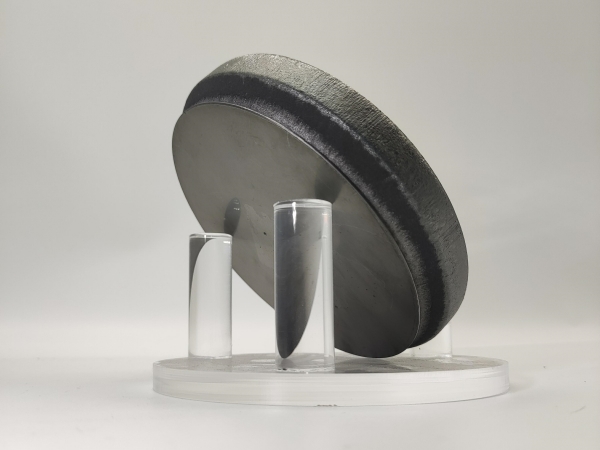
In the field of advanced packaging, 12-inch sapphire wafers, fused silica wafers, silicon wafers, and silicon carbide (SiC) wafers each play distinct roles due to their fundamentally different material properties. These differences determine their respective suitability for specific packaging architectures and performance requirements.
This article provides a comprehensive comparison from three perspectives: core material properties, application scenarios, and usage considerations.

I. Comparison of Core Material Properties
| Property |
12-inch Sapphire Wafer |
12-inch Fused Silica Wafer |
12-inch Silicon Wafer |
12-inch Silicon Carbide Wafer |
| Chemical Composition |
Single-crystal alumina (Al₂O₃), purity ≥ 99.99% |
High-purity silicon dioxide (SiO₂, amorphous), impurity content < 10 ppm |
Single-crystal silicon, purity ≥ 99.999999999% |
Single-crystal silicon carbide (SiC) |
| Thermal Conductivity |
Relatively low, ~25 W/(m·K) at 100 °C |
Moderate, significantly lower than Si and SiC, slightly higher than sapphire |
Good, ~150 W/(m·K), sufficient for most device thermal requirements |
Excellent, up to 490 W/(m·K), more than 10× that of sapphire |
| Electrical Properties |
Electrical insulator, resistivity > 10¹¹ Ω·cm at room temperature; vertical devices not feasible |
Excellent insulation, dielectric constant ~3.78 @ 1 MHz, virtually non-conductive |
Semiconductor; conductivity can be precisely tuned by doping |
Low-resistivity material enabling vertical current conduction, suitable for high-voltage devices |
| Mechanical & Thermal Stability |
Extremely high hardness (second only to diamond), withstands temperatures up to 2050 °C, excellent corrosion resistance |
Ultra-low thermal expansion; dimensionally stable from −190 °C to 1100 °C; melting point 1713 °C; resistant to most chemicals except HF |
Moderate mechanical strength, easy to process; limited high-temperature stability with slight deformation at elevated temperatures |
High mechanical strength, withstands >2000 °C, excellent thermal shock resistance |
| Manufacturing Difficulty |
Very high hardness; thinning and cutting require specialized equipment; high processing cost; Tianjing Intelligent achieves >97% mass-production yield |
Micron-level processing precision achievable; compatible with laser cutting and ion beam polishing |
Most mature manufacturing ecosystem; conventional diamond cutting and CMP processes; stable yield |
Extremely challenging manufacturing; high-temperature PVT crystal growth; defect control difficult; high material loss during slicing and grinding |
II. Application Guidelines for Each Wafer Type
(1) 12-Inch Sapphire Wafers
Application Scenarios:
Sapphire wafers are primarily used in
GaN-based device packaging and Micro LED display applications. As a mainstream substrate for GaN epitaxial growth, sapphire’s high-temperature resistance enables compatibility with GaN device packaging processes, making it suitable for
RF device packaging in 5G/6G base stations.
In Micro LED packaging, sapphire’s
ultra-high surface flatness (≈0.2 nm) supports high-yield mass transfer processes. The 12-inch format significantly increases chip count per packaging cycle, reducing cost per die. Sapphire is also used as an auxiliary substrate in certain optical and power device packaging applications.
Usage Considerations:
Due to its relatively low thermal conductivity, additional thermal management structures are required for high-power devices. Its insulating nature restricts electrode formation to the top surface, requiring optimized electrode design to avoid degrading optical or electrical performance.
(2) 12-Inch Fused Silica Wafers
Application Scenarios:
Fused silica wafers are mainly used in
lithography support processes and high-precision optical or RF device packaging. In advanced packaging lithography, they serve as etching masks or high-temperature carrier substrates. Their high optical transmittance from ultraviolet to far-infrared wavelengths ensures compatibility with photolithography exposure paths.
They are also well-suited for
MEMS sensors and SAW filter packaging, where excellent insulation and dimensional stability help maintain signal integrity. Additionally,
fused silica wafers are often used as auxiliary carrier components during wafer-level packaging.
Usage Considerations:
Contact with hydrofluoric acid must be strictly avoided, and cleaning processes should exclude fluorine-containing chemicals. Although thermally stable, fused silica has limited mechanical strength, requiring careful handling during packaging and transport to prevent fracture.
(3) 12-Inch Silicon Wafers
Application Scenarios:
Silicon wafers remain the
mainstream substrate for general-purpose semiconductor packaging, serving consumer electronics, automotive electronics, and data center applications. They are widely used in packaging processors for smartphones, memory chips for laptops, as well as high-performance chips for autonomous driving systems and servers.
Silicon’s semiconductor nature supports both
lateral (L-type) and vertical (V-type) electrode configurations, allowing packaging engineers to balance luminous area and electrical efficiency through process optimization. The 12-inch format enables large-scale integration and significantly reduces unit manufacturing costs.
Usage Considerations:
For high-temperature device packaging, process temperatures must be carefully controlled to prevent wafer warpage. The ultra-high purity requirement necessitates thorough pre-packaging cleaning to eliminate surface contamination that could degrade device performance.
(4) 12-Inch Silicon Carbide Wafers
Application Scenarios:
Silicon carbide wafers are targeted at
high-end power devices and applications with extreme thermal management requirements. In AI data centers, their exceptional thermal conductivity effectively mitigates heat accumulation from increasing power density.
They are widely used in
electric vehicle power modules and grid-level high-voltage transmission devices, enabling higher energy conversion efficiency and reduced system size. SiC wafers are also applied in
AR/VR optical system packaging, where controlled refractive properties enhance display performance. Furthermore, they support high-voltage power delivery integration in advanced packaging platforms such as
CoWoS.
Usage Considerations:
Due to their high cost, SiC wafers are best suited for high-value, high-performance devices. Specialized cutting and polishing equipment is required to prevent defect propagation. Although lattice matching with epitaxial layers is superior to sapphire, stress management through optimized packaging processes remains essential.

Conclusion
Each 12-inch wafer material—
sapphire, fused silica, silicon, and silicon carbide—serves a distinct role in advanced packaging. Their selection must be guided by a comprehensive evaluation of
thermal performance, electrical characteristics, mechanical stability, manufacturability, and cost, ensuring optimal alignment with device requirements and system-level performance targets.